Saturday, July 14, 2012

The Sandcastle Girls by Chris Bohjalian

Nineteen-fifteen is the year of the Slaughter You Know Nothing About.  The anniversary of its commencement – is nearing.  If you are not Armenian, you probably know little about the deportations and massacres: the death of a million and a half civilians. That’s the simple way Laura Petrosian, a central character in Chris Bohjalian’s new novel, introduces the theme of this informative and evocative story.  Laura, a popular novelist, is by her own admission “obsessed and unstoppable” in her quest to know the details of her grandparents’ lives during the 1915 Armenian genocide. And so the novel itself begins with Elizabeth Endicott’s arrival in Allepo, Syria after her recent graduation from Mount Holyoke.  She’s part of a Boston Friends of Armenia group there to bring food and supplies to what our grandparents called “the starving Armenians.”  She soon meets Armen, an engineer, who’s lost his wife and baby and who soon joins the British Army to fight the Turks. Armen and Elizabeth correspond and fall in love and the novel veers to the present day when Laura Petrosian begins to learn of her grandparents’ past.

Elizabeth and Armen are complex characters whose lives make this little known time seem real and who make the reader realize that what happened in Armenia in 1915 is essential to our understanding of Turkey and the Middle East today. Mr. Bohjalian, himself an American novelist of Armenian descent, infuses this novel with a realism and heartfelt resonance informed and impassioned by his own connection and the stories he’s undoubtedly heard since childhood.

When Laura ponders, “my brother thinks trying to chronicle our grandparents’ story is a spectacular waste of literary capital and can only inflame tensions between Turks and Armenians. . . Everyone would be better off . . . if I just wrote another domestic comedy” the reader wonders if Bohjalian had such questioners.  And he deftly answers the query with, “But history does matter.  There is a line between the Armenians and the Jews and the Cambodians and the Serbs and the Rwandans.  There are obviously more, but really, how much genocide can one sentence handle?  You get the point”.  And we do get the point because Bohjalian makes us care deeply about Armen and Elizabeth and a girl named Hatoun.

The novel helps us understand how the term “Young Turks” came into our vernacular as it was three young Turks led by Talet Pasha who initiated and staged the genocide and who were found guilty by a Turkish court of “the massacre and destruction of the Armenians.” That history is informative but Bohjalian takes it a step further by having Laura’s research find that “If you visit Ankara or Istanbul today, you will find streets and schools named for Talat Pasha” (and the other young Turks). “the nation that found Talat Pasha guilty of attempting to wipe out a race of people later named concourses after him.  How is that possible?  Because, to much of the nation – though, thankfully, not all – that genocide in the desert never happened.  Even now, labeling the slaughter of 1915 “genocide” can land a Turkish citizen in jail and get a Turkish Armenian journalist killed.”

I believe and hope that Bohjalian’s naming of the courageous and kind Turkish private Orhan in the book was homage to Nobel Prize winner Orhan Pamuk, a Turkish author, who was arrested for stating the facts of the genocide.

Summing it Up: This epic, historical love story begs for discussion. Upon finishing it, readers will want to find others to talk with about Laura and Armen’s love, about Nevart, Hatoun, Dr. Akham and the other minor characters whose lives make this novel cinematic in scope and about what we should do to make sure this atrocity is never forgotten.  It also contains unexpected twists that book clubs will love to debate.

Footnote: I spoke with Mr. Bohjalian today when he appeared at a luncheon in Harbor Springs and he confirmed that the kind Turkish pirate Orhan is in fact named in tribute to author Orhan Pamuk.  If you have a chance visit the author website for upcoming appearances throughout the U. S. Bohjalian's presentation is fascinating and includes many photographs of sites in Lebanon and Turkey that he visited in the last year. 


Rating: 5 stars   

Category: Grandma’s Pot Roast, Historical Fiction, Super Nutrition, Book Club

Publication date: July 17, 2012


What Others are Saying:


Kirkus Reviews: https://www.kirkusreviews.com/book-reviews/chris-bohjalian/sandcastle-girls/#review  (Beware, this review contains spoilers even at the beginning.)


Sunday, July 1, 2012

Behind the Beautiful Forevers by Katherine Boo


Readers, buy this book! Make a bookmark with the words: THIS IS NON FICTION in large letters and keep it as a reminder because you'll swear this is a novel.  Pulitzer Prize winning journalist Katherine Boo has brilliantly succeeded in making the story of "life, death, and hope in a Mumbai undercity" radiate with energy and emotion.  How a non-fiction writer could develop characters and capture dialogue while staying true to facts that illuminate the story of Annawadi, a self-developed slum of 3,000 people living on half an acre on the outskirts of the Mumbai airport, is a testament to Boo’s ability to embed herself, listen and then etch an indelible picture that makes the reader know, yes, really know, those residents. After more than three years of research with translators beside her, all of whom had constant fevers and infections from the filthy conditions, Boo captures the heart of the community.  She paints each resident with a palette that shows many transcending their surroundings.

Abdul, a Muslim teen, is trying to get his family out of the slum through his ability to find and resell recyclables and by his adherence to his motto:  avoid trouble.  But, in Annawadi, trouble comes unbidden when Fatima, the foul-mouthed, one-legged harridan, accuses Abdul of a crime he didn’t commit.

Asha, who’s turning forty, dreams of becoming Annawadi’s first female slum lord and gains success as an influence peddler.  Her daughter Manju is about to become the area’s first female college graduate if her other duties and a possible arranged marriage don’t derail it.  Kalu, a fifteen-year-old scrap metal thief, is a joyful mischief maker.  Boo makes the reader value Annawadi’s residents while they see daily reminders that they are of no worth to others. In a place where teens debate the best suicide methods and see death daily, Kalu’s friend Sunil, climbs to a roof top where “something he’s come to realize . . . looking out, thinking about what would happen if he leaned too far, was that a boy’s life could still matter to himself.”

Boo reports the residents’ thoughts as in Abdul’s pondering: “Water and ice were made of the same thing.  He thought most people were made of the same thing too. But here was the interesting thing. Ice was distinct from – and in his view, better than – what it was made of.  He wanted to be better than what he was made of.  In Mumbai’s dirty water, he wanted to be ice.”

Whatever you’ve read or thought about India today, this book will turn it upside down.  It will sadden you and it will make your heart sing with hope.  Most of all it will make you thankful that there are writers with Boo’s talent and tenacity who are willing to sacrifice to show the real Mumbai. Out of filth, Katherine Boo has created a magnificent ice sculpture of a book.

When Kirkus Reviews, arguably the toughest book critics in the business, call a book: “The best book yet written on India in the throes of a brutal transition,” you know you’re in good hands.

Rating: 5 stars   

Category: Nonfiction, Gourmet, Super Nutrition, Book Club

Publication date: February 7, 2012


What Others are Saying:


Thursday, June 14, 2012

Father's Day Finds

Whether choosing a book for a Dad in his twenties or a Grandpa in his eighties, there are many exhilarating choices among the newest books that will help your special Dad celebrate.

Imperfect, An Improbable Life by Jim Abbott and Tim Brown is my pick for every parent and baseball lover on your list.  Born without a right hand, Jim Abbott was an implausible candidate to pitch a big league no-hitter, yet he did.  The way his parents used his supposed handicap as an opportunity is an inspiration for everyone.  Abbott’s honesty and humor enlighten his journey and Brown’s skillful inning-by-inning rendition of Abbott’s no-hitter in Yankee Stadium will entertain readers.

Calico Joe by John Grisham is a kind novel about fatherhood and forgiveness as seen through the eyes of the son of a blackguard pitcher in 1973 and today. It’s a book fathers should share with their teenage sons and it isn’t just for baseball fans but will appeal to readers looking for a heartwarming story.

Defending Jacob by William Landay is a fast-paced courtroom drama and story of the son of a district attorney who’s accused of killing his classmate.  As the father tries to save his son, he has to ask if a tendency to violence is an inheritable trait and then to explore his own past.  The courtroom scenes are crisp and realistic as the author is a former district attorney.  The book will keep readers on edge until the very clever ending.

The Starboard Sea by Amber Dermont is a novel that explores taking the right course in life as experienced in a boarding school that takes in those who’ve been tossed from the good schools yet have family money and influence. It uses sailing as a metaphor for searching for a guiding star and also explores father-son relationships.  It’s a book that succeeds on many levels.

The 500: a Novel by Matthew Quirk is a debut thriller set in the powerful world of Washington lobbyists with unchallenged power.  Mike Ford, a recent Harvard Law School grad with a past, is riding high until he discovers secrets that turn his world into something resembling The Firm. 

Also don’t miss two of my favorite books of 2011 that everyone would love and that would make perfect gifts for Father’s Day:

The Art of Fielding by Chad Harbach is for every reader. Henry arrives at a small college on the shores of Lake Michigan to play baseball; perhaps to save the team with his fielding. He becomes the best until he makes on unforced error and everything changes. You’ll remember his captivating teammates long after flying through this big, heartfelt book.  Don’t think that you have to know about or love baseball to enjoy this novel.  Trying to live without ever making an error is certainly a metaphor for life not just for baseball.  The characters in this connect with more than just baseball fans.

Safe from the Sea, by Peter Geye - Noah returns to the remote lake region north of Duluth when Olaf, his ill father, summons him. The novel also tells of Olaf’s survival of one of the most deadly Lake Superior shipwrecks. Lyrical prose highlights this tale of forgiveness, love and honoring the past.

Take a step back to a favorite from the 1990s:

The Last Days of Summer by Steve Kluger is both the funniest and most poignant baseball novel I’ve ever read.  Told in letters by a boy to his New York Giants hero in the 1940s it will make even the most reluctant reader sit for hours guffawing.  Fathers and sons must share this. 

Tuesday, May 8, 2012

Maurice Sendak

Maurice Sendak died today at age 83.  I spent 45 incredible minutes listening  to and wiping away tears from a tribute to Mr. Sendak on Fresh Air today:  Sendak's comments to Terry Gross at the end should remind us all to live each day as if it were our last.  


To see the more caustic side of Sendak, watch his recent interview with Stephen Colbert.  This is the second part of the interview which is about children's literature.

Mr. Sendak, thank you for the wonderful illustrations in the Little Bear series.  Those pictures helped me learn to be a parent. Thank you for Pierre and making it okay to say "I don't care" even if a certain child drove me nuts repeating it.   May you "sail off through night and day and in and out of weeks to where the wild things are."  Rest in peace. 

Monday, May 7, 2012

Books for Mother's Day

With Mother’s Day fast approaching here are some ideas for the special mother or grandmother in your life:

Lots of Candles, Plenty of Cake by Anna Quindlen is a witty, caring, kind, and thought-provoking memoir/essay collection filled with observations by the Pulitzer Prize winner.  It reads as if Quindlen were the friend who knows you better than yourself sitting across the table enjoying lunch while talking about the rigors of aging, marriage, family and best of all friendship.  If your mother values her friends then this wise volume will be a gift she’ll cherish.  Quindlen, the queen of the quotidian, has hit a home run with this one.

The Red Book by Deborah Copaken Kogan is a compulsive page-turner based on Harvard’s famed, every-five-year, red-covered book featuring short essays about graduates’ personal and career details.  The class of ’89 is arriving in Cambridge for their twentieth reunion and all is not exactly as the Red Book says.  Mom will enjoy this homage to living an authentic life with those you love.  It’s packed with romance and sensual rendezvous.  While at first a witty, seemingly carefree novel about beautiful people who have it all, it soon percolates with secrets, betrayals, forgiveness and all that gives life meaning.

The Darlings by Cristina Alger brings the financial crisis to a human level. Merrill Darling, the daughter of a billionaire financier and her lawyer husband Paul Ross live a perfect life until things go tragically wrong.  Money, power, the SEC, hedge funds, and a delightful dose of engaging characters make this novel soar.

More Than You Know, a novel by Penny Vincenzi, is 589 pages that Mom might just read in a day or two (if you do the dishes and the laundry).  If Mom likes fashion, British sagas and revisiting the 1960s and 70s then she’ll adore this romp of a romantic comedy.  Vincenzi’s Lytton family trilogy was hugely successful and this tale of Eliza, an upper class fashion editor who falls for a driven-to-succeed working-class mate, should appeal to the same readers.  Stir in Summercourt, the family estate that may be lost due to a downturn in the family resources, and you have a perfectly delectable read for a long flight or for those awaiting more of Downton Abbey. 

Wednesday, April 18, 2012

No Pulitzer Prize for Fiction. . .

I'm angry and confused. I've been trying to fathom why the Pulitzer Prize Board would have the audacity NOT to choose a Fiction winner this year. They said none of the three books selected by the jury received a majority and that's all they said.  My first thoughts were that they were emulating Congress.  Then like some others I wondered if they thought that the brilliant Train Dreams, a novella of just 128 pages, was too short but that couldn't be it as they set the rules and the rules don't specify length.  I tried to guess if some of them might find Swamplandia, the winner of The National Book Award, too imaginative or if they didn't like the idea of The Pale King being compiled posthumously.  No reason seems acceptable for the Board to ignore the fine recommendations of a highly regarded jury. Those jurors, Maureen Corrigan, Michael Cunningham, and Susan Larson also expressed shock and disappointment at the slight. 

To me this has been an exceptional year for fiction.  Books like State of Wonder, Lost Memory of Skin, Once Upon a River, and The Buddha in the Attic would all have been worthy of the Prize. One outcome of this travesty has been that many others have decried this inaction and have provided lists of fine books that readers might choose despite the Pulitzer snub.  Ann Patchett wrote a great op-ed piece on the subject.  The Wall Street Journal asked several prominent and esteemed critics to list the books they would have chosen and they had very little trouble coming up with several.  The Washington Post's Ron Charles then noted "but to not choose any book is just a snobby slap in the face for those of us who enjoyed so many fine novels last year." 

I've read the names of the members of the Pulitzer Prize Board and they're exceptional people I hold in high esteem but I wonder what happened to keep them from choosing a prize winner. 


Wednesday, April 11, 2012

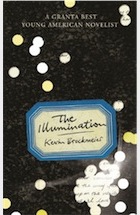
The Illumination by Kevin Brockmeier


What if one Friday evening, every wound began to shine? What if every broken bone, every bruise, every cancerous cell – yes every injury began to glow and shimmer?  That’s what occurs in Brockmeier’s masterpiece of a speculative novel that tells the stories of those who are injured, hurting, and revealing their pain to the world.  The very light that radiates from the wounds illuminates the characters, the writing and the novel into a shining original that will keep you captivated from the first page beginning with Carol Ann’s story as she cuts herself while opening a package and has to go to the emergency room.  While in the hospital Carol Ann picks up a journal of love notes that passes through the hands of each of the five other major characters in the novel and ties them together.

When Carol returns to work she notes: Everyone, everyone, everyone, and all the time.  The world had changed in the wake of the Illumination.  No one could disguise his pain anymore.  You could hardly step out in public without noticing the white blaze of someone’s impacted heel showing through her slingbacks; and over there, hailing a taxi, a woman with shimmering pressure marks where her pants cut into her gut; and behind her, beneath the awning of the flower shop, a man lit all over in a glory of leukemia.
At work, Carol Anne took to scouring the Internet for images of political and business leaders with the angry flush of renal disease, the barbed-wire knot of a blocked artery, or any of the hundreds of other telltale patterns of resplendence she had learned to recognize. She included these pictures in her news packets without comment. And if her hand flared in pain while she was delivering a hard copy to her boss, and if the silver light of a toothache shone from his mouth as he said thank you, the two of them might make a small motion of their heads in sympathy, but they would not say a word.  It was important that the workplace remain professional.  They all tried their best not to acknowledge one another’s suffering.  Even when one of the receptionists came in with belt-strap bruises radiating through the front of her shirt, wincing each time she reached to open the filing cabinet, the rest of the staff avoided saying anything to her.

They all tried their best not to acknowledge one another’s suffering.  That line has refused to leave my mind despite my efforts to suppress it.  Isn’t that what we do every day, rationalizing that it keeps us sane, that we have enough to handle?  Don’t we spend our days trying not to see anyone else’s pain, suffering or misfortune?  My facile ignoring or should I say ignorance of the suffering of others cannot remain as buried now that I’ve read The Illumination.   Isn’t that what great books do to us?  Don’t they force us to confront those places where we refuse to be human?  Kevin Brockmeier’s The Illumination challenges readers to see both self and the world in all its pain and glory.

And those “bleeping” epigraphs at the beginning of each section – come on Mr. Brockmeier, don’t you understand that I have a life?  Sometimes I had to meditate far beyond my ability to sit still to ponder them. And quoting Whittaker Chambers makes me wonder if you want me to think a tad too much:  The reality cuts across our minds like a wound whose edges crave to heal, but cannot.  Thus, one of the great sins, perhaps the great sin, is to say: It will heal; it has healed; there is no wound; there is something more important than this wound.  There is nothing more important than this wound.  Mr. Brockmeier, don’t you understand that if you want to sell more books you’re going to have to give me time to let this one go and  let me pretend that all my wounds have healed and that my life is “just fine, thank you.”  And you just had to use that epigraph at the beginning of the chapter on Jason Williford, the photojournalist, whose journal of love notes ties the entire book together and who attempts to leave his own wounds behind by inflicting new ones that while more visible – hurt less.

I don’t read much fantasy.  I love Margaret Atwood and Kazuo Ishiguro but my pedestrian mind seems to consider them exceptions.  So I keep avoiding speculative fiction because so many books in the genre exhibit contrived plot-driven drivel.   But Kevin Brockmeier’s The Illumination, a book I had to wait weeks to review as I was still absorbing its impact and trying to avoid what it might be telling me, is a book everyone, even those who don’t think they like speculative fiction should read. And, fear not, the writing is so good that the premise will seem absolutely reasonable to even the least imaginative reader. National Public Radio, The Seattle Times and The Kansas City Star named it a Best Book of the Year for 2011. 

Summing it Up:  Read this for the fine character studies, the challenging premise and the brilliant writing.  Convince your book club or a good friend to read it as well so you’ll have someone to talk with when it wakes you up in the night weeks after you’ve put it down.

Rating: 5 stars    Category: Fiction, Gourmet, Soul Food, Book Club

Publication date: February, 2011


What Others are Saying: