Wednesday, February 22, 2017

Girl Up by Laura Bates


Girl Up is not a book I’d normally review partly because it isn’t yet available in the U.S. (It was published in England last spring and will be out in the U.S. in July.)  Laura Bates, the founder of the Everyday Sexism Project and author of the ground breaking Everyday Sexism, wrote Girl Up to give teenage girls and young women a voice. She wrote it to counter the prevalent messages all teenage girls hear. On the opening page she tells girls that since they were babies, they’ve been getting messages about who they are and how the world sees them, messages that are all around them, all the time.
“They said you need to be thin and beautiful.
They told you to wear longer skirts, avoid going out late at night and move in groups. Never accept drinks from a stranger, and wear shoes you can run in more easily than heels.
They instructed you to wear just enough make-up to look ‘presentable’ but not enough to be a slag; to dress to flatter your apple, pear, hourglass figure, but not to be too slutty.
They warned you if you’re strong, opinionated, or take control, you’ll be shrill, bossy, a ballbreaker.
They asked you why you can’t take a joke.
They informed you that you should know your place.
The told you ‘that’s not for girls’; ‘take it as a compliment’; ‘don’t rock the boat’; ‘that’ll go straight to your hips’; ‘smile darling.’ They told you that ‘beauty is on the inside’ but you knew they didn’t really mean it.

Well, f*&% that. I’m here to tell you something else.”

Another reason why this isn't a title I'd typically include on this blog is that it’s filled to the brim and overflowing with the “f” word, with slang words for genitalia, and with statements and drawings that might embarrass some adult readers. However, many adult readers aren't the intended audience for this book (unless they’re teachers, parents, or counselors – then they need to read it).


From the reviews and comments I’ve read in British publications, girls thirteen and older can’t get enough of this book and love quoting parts of it to their friends and even to their mothers. This book is a game changer. This book is a survival guide for today’s teens and young women.
The main reason I am reviewing Girl Up now is that it allows me to share the following paragraph. If you have a teenager (boy or girl) living in your home, if you teach teenagers, if you know a teenager, or if you are a human being – read the next section.

“. . . sex is a lot like ice cream. . .
What’s most important of all is that you’d never force feed ice cream to somebody who said they didn’t want any. What a weird thing to do. People eat ice cream because they enjoy it, or it makes them feel good, or it’s a pleasurable thing to enjoy on their own or with somebody they’re close to. Nobody experiences any of these feelings from being force-fed ice cream when they don’t feel like it. You’d never turn up at someone’s house and prise a spoon between their lips unexpectedly without offering them ice cream first. Even if you came over planning to have ice cream, if they don’t want any you’d put it away again. It doesn’t stop you from going off and having some ice cream on your own, but you can’t force them to have any if they don’t feel like it. Even if someone initially thought they felt like ice cream, and got out the bowls and spoons, it’s still completely their right to decide if they change their mind and don’t want any after all. They equally have every right to push the bowl away in the middle of a scoop if they’ve had enough, or decide they want to stop eating it. If someone has decided they want one particular flavor of ice cream, you wouldn’t suddenly shove a different kind in their mouth while they’re in the middle of eating it.  If they were asleep, or unconscious, or very drunk, you wouldn’t just randomly start feeding it to them. And having ice cream with someone once doesn’t give you the right to just assume they’ll always want to split a sundae with you in the future. 

All these things also apply to sexual consent.”

Now, do you understand why I think this book is important and why I don't want to wait until July to tell you about it? Before July, you can contact your local independent book store (used or new) and ask them to get it for you now or to preorder it. You can also locate it online from sources like Abe Books, https://www.abebooks.com Alibris http://www.alibris.com/ or Powell’s www.powells.com
 
If you’re a parent, teacher, counselor, or anyone working with teenagers, promise me that you’ll find a way to read this book and that you’ll share it. After you read it, talk about it with others and figure out a way to get it into the hands of the girls you know.

Summing it Up: Girl Up is brilliant; it’s bold, profane, sarcastic, and just what teenage girls and young women deserve to have in their corner. If you’re a parent, teacher, counselor, or just someone who cares about the future of girls, read this book. Don’t worry, I’ll be back in July to remind you when Girl Up hits the U.S. shelves.
.
Rating: 5 stars   
Category: Diet Coke and Gummi Bears, Five Stars, Nonfiction, Super Nutrition, Sushi with Green Tea Sorbet
Publication date: April, 2016 (in Great Britain), July, 2017 in the U.S.
The Everyday Sexism Site: http://everydaysexism.com/


What Others are Saying:


Monday, February 20, 2017

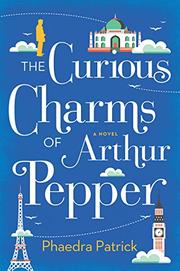
The Curious Charms of Arthur Pepper by Phaedra Patrick


Readers, you’ve been asking me for recommendations of novels similar to A Man Called Ove, The Unlikely Pilgrimage of Harold Fry, and Major Pettigrew’s Last Stand. Several of you, especially those living in areas hard hit by winter, have asked me to suggest a charmer. So, a literal charmer it is. The Curious Charms of Arthur Pepper follows 69-year-old Arthur Pepper, a Yorkshire widower, as he leaves his contented comfort zone of a home to discover the stories behind the eight charms on his late wife Miriam’s gold charm bracelet. 

Each day, Arthur got out of bed at precisely 7:30 a.m. just as he did when his wife, Miriam, was alive. He showered and got dressed in the grey slacks, pale blue shirt and mustard tank top that he had laid out the night before. He had a shave then went downstairs.

At eight o’clock he made his breakfast, usually a slice of toast and margarine, and he sat at the pine farmhouse table that could seat six, but which now just seated one. At eight-thirty he would rinse his pots and wipe down the kitchen worktop using the flat of his hand and then two lemon-scented Flash wipes. Then his day could begin. . .

But today, the fifteenth day of the month, was different. It was the anniversary he had been dreading for weeks. The date on his Stunning Scarborough calendar caught his eye whenever he passed it. He would stare at it for a moment then try to find a small job to distract him. He would water his fern, Frederica, or open the kitchen window and shout ‘Gerroff’ to deter next door’s cats from using his rockery as a toilet.

It was one year to the day that his wife had died.

Arthur has a tenuous relationship with his two grown children. Neither one attended Miriam’s funeral. His son who lives in Australia cited the distance and business needs and his daughter who lives nearby wasn’t feeling well. Thus, Arthur has turned inward and relies on his daily habits to distract him from his woes. Finding the charm bracelet, a piece of jewelry that was entirely unlike anything Miriam would ever have worn, shakes Arthur out of his doldrums. As he heads to London and places beyond, his naiveté leads him into trouble while each escapade offers growth.

The Curious Charms of Arthur Pepper isn’t literature with a capital “L,” instead, it’s a heart-warming story best told by a narrator with a British accent. This is a book to be heard, not read. Pretend that you’re a child and listen to this book as you sit in a cozy chair or drive off on a road trip to warmer climes. James Langton, the novel’s narrator, was born in York, England and studied at the Royal Scottish Academy of Music and Drama. His voice is absolutely spot-on in evoking Arthur and those he encounters.

I’ve read several novels using charm bracelets, letters, and other mementos as plot devices and most have been saccharine wastes of my time. The Curious Charms of Arthur Pepper with its wry humor, cast of unexpected characters, and yes, even the lessons it imparted, was an enchanting trek into a life I thoroughly enjoyed observing.

Listening to Arthur and his adventures made many a trip on Chicago’s not so delightful expressways enjoyable. I wonder if those who saw me as I stepped out of my car with a giant smile on my face imagined that it was a book that had me smiling. Arthur’s grief and his probable depression are expressed through a candid portrait of sincere emotional anguish, but the book is never maudlin. Rarely do I drive along laughing out loud then seconds later shed a tear while heading for my exit and I thank author Phaedra Patrick and narrator James Langton for providing such an adventure.

Summing it Up: Listen to The Curious Charms of Arthur Pepper for a sentimental novel that will charm you, make you laugh, and brighten your worst day. This quintessentially British tale is as perfect for a winter day as a cup of tea and a hand knit afghan. If your book club is looking for relief from reading too many heavy tomes, this will be a “blinding” (excellent) choice. If you choose to read the novel in print the paperback edition was released on January 31, 2017.

Rating: 4 stars   

Category: Fiction, Dessert, Grandma’s Pot Roast, Road Food, Book Club

Publication date: May 3, 2016


What Others are Saying:


“Phaedra Patrick understands the soul. Eccentric, charming, and wise, The Curious Charms of Arthur Pepper is about finding courage, generosity, and compassion, even when all seems lost. With clear-eyed prose and a moving story, Patrick reminds us how selfless people can be – she reminds us to be brave. The Curious Charms is not just for those who are mourning over love or the past. This book will illuminate your heart.” – Nina George, New York Times bestselling author of The Little Paris Bookshop

Tuesday, February 14, 2017

One Good Mama Bone by Bren McClain


One Good Mama Bone’s first sentences are enough to capture even the most demanding reader’s attention.

“One night, deep into it, when sounds are prone to carry, a baby boy lies crying on Sarah Creamer’s kitchen table. He is minutes old, still wet with his mother’s blood, and hungry for his mother’s milk.


But she does not hear his cries. She is no longer there.


Only Sarah. Only Sarah remains. Her body bent over his, her hands rummaging the wooden planks for a towel still white enough to wrap him in. Blood is everywhere, puddled up as if there had been a hard rain. The smell of it saturates the eighty-one-degree air, pushes aside the dry tang of bleach, and fills the heat with the moistness of a long-shuttered earth, now free.


The baby’s cries penetrate Sarah’s bosom and bounce around its emptiness.”


Those sentences offer the promise of a good story with fine writing and the rest of One Good Mama Bone delivers on that promise. The book opens in 1944 on the day of Emerson Bridge’s birth and his mother Mattie’s death. It soon skips ahead to a dark November day in 1950 when a mother cow delivers twin calves in an empty pasture where she watches her first-born, a female calf, die. With fierce determination, the mother cow returns to her feet and saves her second-born, a male calf, with no one around to show her what to do.

“She would know, and it would come from a place deep inside where maternal love lives and maternal love grows, a place that is regardless there, never wavering there, nonnegotiably there.


It lay in her bones.”


Four months later Sarah Creamer’s husband, Harold drinks himself to death and she’s left to raise “her” son Emerson Bridge without a cent to her name and a huge debt on their farm that threatens to leave them homeless. Emerson Bridge is the evidence of the affair Sarah’s best friend and neighbor Mattie had with Harold. Sarah who had lost her only child in a birth that also took her ability to have more babies loves Emerson Bridge unequivocally. Taking care of Emerson Bridge is made difficult because of Sarah’s fears that she can’t be a good mother. Seared in her memory are her mother’s words told to her when she was six, “You-ain’t-got-you-one-good-mama-bone-in-you.”


Sarah is unwavering in her efforts to provide for Emerson Bridge so when she reads in the local newspaper that a boy has won $680 with his Grand Champion steer at the recent Fat Cattle Show & Sale, she sees this as the financial deliverance they need. She obtains a young steer from a neighboring farm, but the calf bellows his discomfort at having been weaned too soon from his mother. Mama Red, the same cow who’d been so determined to save her calf at his birth, breaks through a barbed-wire fence and travels to her calf. She calms and nurses him and teaches Sarah how to be a mother. Soon Sarah is moving toward winning the money that will change their lives, but an evil neighbor threatens her success. Still, Sarah seems primed to win until she realizes just what the price of winning will be.


One of the ingredients that sets this novel apart from the usual tales of motherhood is that it’s Mama Red and her care for her calf and the lessons Sarah absorbs from watching them together that form the novel’s core. The novel is a fine example of the southern tradition of using place to portray the effects of isolation and poverty. Readers may need to acclimate themselves to Sarah’s simple speech, but once under its spell, they’ll see how it delivers them into the world that shaped her. This extraordinarily original novel veers from typical southern fiction in its use of animals as behavioral models. Just as Mama Red’s love for her calf “lay in her bones,” Sarah’s gumption rises out of her being to form one very good mama bone.


One Good Mama Bone brilliantly, yet softly, addresses the deep connection between us and the animals in our world. It delivers a universal tale of love as seen through the compassionate depiction of a mother cow and her star pupil. I don’t lightly compare any book to one of my all-time favorites, but it would be difficult to ignore the similarities that One Good Mama Bone shares with Charlotte’s Web.


Summing it Up: Animal lovers, southern fiction fans, and those who simply like a well-told story will devour One Good Mama Bone just as they would the best home-made biscuits and gravy. There's a reason the late Pat Conroy wanted this for his imprint. Do yourself a favor and read this book.


Rating: 5 stars   


Category: Fiction, Five Stars, Grandma’s Pot Roast, Grits, Pigeon Pie, Book Club


Publication date: February 14, 2017


Q & A with the Author: http://www.brenmcclain.com/qa/


What Others are Saying:


“In spite of being an animal lover all my life and feeling the centrality of that love in how I see the larger world, I have never directly addressed that theme in my writing. I no longer have to. Bren McClain’s brilliant and ravishingly moving One Good Mama Bone speaks eloquently for all of us who find our deepest humanity intimately connected with all the sentient creatures around us. Humane and universal, One Good Mama Bone is an instant classic.” Pulitzer Prize-winning author Robert Olen Butler


“Bren McClain writes of elemental things with grace, wisdom, and power. One Good Mama Bone speaks with a quiet authority that comes through on every page.”  Ben Fountain, author of Billy Lynn’s Long Halftime Walk, winner of the National Book Critics Circle Award for Fiction