Tuesday, April 14, 2015

Searching for Sunday: Loving, Leaving and Finding the Church by Rachael Held Evans

Reading Searching for Sunday is a like being the honored guest at a banquet where the finest chefs have prepared your favorite foods. This memoir of a young woman’s journey to discover what church means and whether there’s a place for her in it will make you contemplate your own faith journey. If you’ve never set foot in a church, read Searching for Sunday to learn what it means to be a part of a church community and why it feels like a family – with all the baggage and the joy a family entails. If you love your church, read it to imagine what you can do to bring more people to the banquet.  If you’re searching for a meaningful church experience, Evans is telling your story. And if you've given up on the church, there are stories here for you. I’m an avid reader of Rachel Held Evans’ blog, I loved hearing her speak, and I’ve read her other books so I expected Searching for Sunday to be special, but it exceeded my expectations because of its honesty, insight, humor, and tenderness.

Evans, the 33-year-old author of A Year of Biblical Womanhood and Faith Unraveled, grew up in the small Tennessee town where the Scopes trial took place and where her father taught theology at a Christian liberal arts college. She grew up evangelical with a capital “E,” but she began to doubt everything she believed about God saying “For me, the trouble started when I began to suspect God was less concerned with saving people from hell than I was.” She had been “intoxicated with certainty.” Once she began questioning, she “became a stranger to the busy, avuncular God who arranged parking spaces for my friends and took prayer requests for weather and election outcomes while leaving thirty thousand children to die each day from preventable disease.” She stopped going to church and started searching. She gave up and started over again. The more she searched, the more she began to believe that
“the church is called to the slow and difficult work of healing. We are called to enter into one another’s pain, anoint it as holy, and stick around no matter the outcome. . . The thing about healing, as opposed to curing, is that it’s relational. It takes time. It’s inefficient, like a meandering river. Rarely does it follow a straight or well-lit path. Rarely does it conform to our expectations or resolve in a timely manner. Walking with someone through grief, or through the process of reconciliation, requires patience, presence, and a willingness to wander, to take the scenic route.”

Searching for Sunday is enhanced by wonderfully appropriate quotes from Barbara Brown Taylor, Nadia Bolz-Weber, William Willimon, and many others including Evans' friend Ed who said “When you join a church, you’re just picking which hot mess is your favorite.”

Organized around seven sacraments with stories and wisdom about baptism, water, confession, communion, confirmation, the anointing of the sick, marriage, and death the book crescendos as Evan’s takes the reader through her experiences. She shows the reader how “God surprises us by showing up in ordinary things, in bread, in wine, in water, in words, in sickness, in healing, in death, in a manger of hay, in a mother’s womb, in an empty tomb.”

Summing it Up: When Publishers Weekly awards its coveted star and writes Honest and moving, this memoir is both theologically astute and beautifully written” you can expect a book that will appeal to more than just the usual suspects who purchase religious tomes. Buy this book because it’s beautifully written, funny, wise, and genuine. Get your friends and neighbors to read it too. If you belong to a church, gather a group to read and discuss it together.

Note: If I were in charge of the world, our political leaders would be required to read Searching for Sunday to see that their work should be relational. Well-meaning Christian politicians should agree to disagree with each other amicably and this book could help them see a way to do just that.

Rating: 5 stars   
Category: Nonfiction, Soul Food, Grandma’s Pot Roast, Book Club
Publication date: April 14, 2015

Author Website: http://rachelheldevans.com/
What Others are Saying:

Monday, April 6, 2015

Inside the O’Briens by Lisa Genova

When Joe O’Brien, a 44-year-old Boston cop, starts falling, fidgeting, dropping objects, having muscle spasms, experiencing memory loss, and throwing things during his increasing bouts of temper, his wife Rosie insists that he see a doctor and his diagnosis is devastating.  He has Huntington’s disease, a fatal disease with no cure. Far worse than the diagnosis is the knowledge that each of their children has a 50-50 chance of having the disease that could lie dormant in them.

The O’Briens live in Charlestown, a Boston Irish Catholic enclave. They own and share a three-story apartment building with their grown children.  J.J., a firefighter, and his wife live on the second floor. Daughter Meghan, a dancer with the Boston Ballet, lives with her sister Katie, a yoga instructor, on the top floor and Joe and Rosie share the first floor apartment with their bartender son Patrick.  Nothing has ever mattered to Rosie other than her faith and keeping her family close to her in Charlestown.

Once their children know of Joe’s diagnosis, they have to decide if they should take the test and find out if they will or won’t get the disease. As these young adults ponder the lives ahead of them, the novel kicks into high gear as it explores what it means to live in doubt, fear, and uncertainty. As Joe states, “Once you can imagine these things, you can’t unimagine them.”

As the practicalities of the disease's ravages begin and Joe and Rosie must face his probable early retirement and the costs of his inevitable care, each of the six family members react differently and it’s their personalities and reactions that make this book so powerful. When one of the children is found to carry the gene, Katie can’t decide whether to take the test. She contemplates whether it’s worse to be positive and face an incurable disease or to be negative while knowing that your beloved sibling is positive. She’s in love and the possibility of the disease hovers over all her decisions about her relationship. Katie is so different from the dreams her parents have for her. Her mindfulness as a yoga instructor has been her core belief, but that was before her father’s diagnosis. Seeing the dynamics of their decisions primarily through the lenses of Katie and her very different parents, makes this book ring true.

Surprisingly, this is a joyful book, a novel that makes you think about living that one life you’ve been given to the fullest. Humor, love, and honesty make this book both a page-turner and an upbeat read.

As Joe’s illness progresses, and he begins to contemplate the worst, Katie tells him “You’re avoiding a future that hasn’t happened yet.” She and the rest of the family have to learn how not to use the disease as an excuse to limit their lives.

Summing it Up: Lisa Genova is a neuroscientist and author who is best known for her novel Still Alice about a woman with Alzheimer’s disease. I didn’t like Still Alice as I found the characters unrealistic and the novel too reliant on emotional appeal so I was pleasantly surprised with Inside the O’Briens. The well-developed, genuine characters, the keen insight into the working of the brain, and an emotional resonance that rings true made Inside the O’Briens a winner. I particularly applaud O’Brien for her development of exceptional minor characters including great medical personnel.  Eric, the genetic counselor, is such a compelling character. I want to read a sequel featuring his life and how he handles his vocation.

This novel will, as one of Katie’s aphorisms states, make you realize that “Every breath is a risk.  Love is why we breathe.”  Read this novel for an emotional roller coaster of a ride alongside a family that learns to live life and love each other. My only quibble with the book is with Genova’s heavy hand as a cheerleader in the fight against Huntington’s.  It’s hard to argue against Genova’s compassionate search for a cure, but the book suffers slightly because of it.

Rating: 4 stars   
Category: Fiction, Grandma’s Pot Roast, Book Club
Publication date: April 7, 2015
Author’s Website: http://lisagenova.com/
What Others are Saying:

Sunday, March 29, 2015

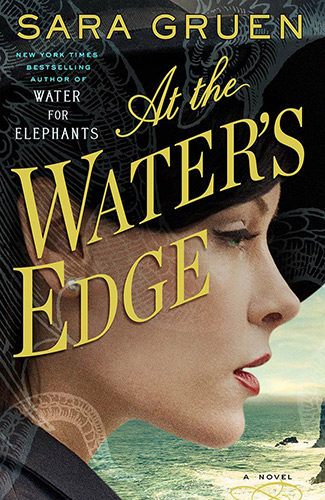
At the Water’s Edge by Sara Gruen

Sometimes you feel like a romance, sometimes you don’t.  If you’re looking for a light period piece, At the Water’s Edge should give you a few hours of pleasure. If you love Downton Abbey primarily for its setting and romantic entanglements, this may be the book for you. If, however, you prefer highly developed characters and a complex plot alongside your highlands, scullery maids, and love triangles, At the Water’s Edge won’t be your cup of Earl Gray.

It’s hard to conceive that the same writer who wrote Water for Elephants also penned At the Water’s Edge. The word water seems to be their only similarity.  At the Water’s Edge is a frothy World War II romance featuring a gruff war hero, caricatured hardworking Scots, and two American wastrels hiding from their lack of gumption and honesty while accompanied by a naive American girl in Scotland in search of the Loch Ness Monster.

Maddie and Ellis are newlywed American socialites. Maddie travels with Ellis and his best friend Hank to Scotland where they hope to redeem themselves and their fortunes.  After a harrowing, wartime sea journey, they arrive in the tiny town of Drumnadrochit in January, 1945, so Ellis and Hank can search for the monster that Ellis’s father had once chased. Upon arriving, Maddie opines:
“To say that I wished I wasn’t there would be a ludicrous understatement, but I’d only ever had the illusion of choice.  We have to do this, Hank had said. It’s for Ellis.
To refuse would have been tantamount to betrayal, an act of calculated cruelty. And so, because of my husband’s war with his father and their insane obsession with a mythical monster, we’d crossed the Atlantic at the very same time a real madman, a real monster, was attempting to take over the world for his own reasons of ego and pride.”

Thus begins Gruen’s quest to show that the sins of selfishness and arrogance don't just belong to classical madmen like Hitler. Meanwhile Maddie makes friends among the villagers, abandons her own pride, and learns that everything isn’t as she’d believed. Gruen pens word pictures like that of Maddie watching Ellis lecture her:
“I stared in fascination, watching his tongue undulate behind his teeth. Once, a string of saliva attached itself to his lips and survived the length of a few words before snapping. His nostrils flared beneath his pinched bridge. Deep lines appeared above his eyes, and when he tilted his chin so he could look down his nose at me, I could have sworn I was looking at his mother’s head spliced onto his body, a living, breathing cockentrice that had climbed off its platter and spat the apple out of its mouth so it could yammer at me about how surely even I could see that blurred boundaries not only encouraged the lower classes to be lazy, but threatened the very social structures our lives were built upon.”

Gruen’s language is carefully constructed yet it doesn't seem supported by the predictable storyline and the one-dimensional characters whose actions rarely surprise. Still, if you're looking for a Mother's Day or birthday gift for your mother, aunt, sister, or friend and she loves historical romances with a touch of sex and a guaranteed happy ending, At the Water's Edge will make her day.

Summing it Up: If I were on a long flight to Scotland, this might help me pass the time while filling me with visions of crofts, air raids, love scenes, and happy endings. If, however, you’re looking for historical fiction with more heft, this isn’t it. Just as the tea Maddie sips tastes like boiled twigs, this novel reads like a watered-down version of life during wartime.

Rating: 2 stars   

Category: Chinese Carryout, Fiction, Historical Fiction (Pigeon Pie)
Publication date: March 31, 2015

What Others are Saying:

Thursday, March 26, 2015

A Spool of Blue Thread by Anne Tyler

The stories we tell define us. What we enjoy reading typifies us as well. Some of us want books with lots of action.  Others prefer subtle mirrors into their own lives. Pulitzer Prize winner Anne Tyler’s A Spool of Blue Thread is the latter, a novel about life as most people live it, a book in which going for a walk is an event. Critics are divided on Tyler’s twentieth novel. The Chicago Tribune says it’s “probably the best novel you will read all year.” The New York Times published two reviews – one glowing and one by the irascible Michiko Kakutani who found it predictable. I love it because of its predictability. Tyler’s third person narration that drops me into the Whitshank family while standing back and allowing me to settle into the rhythm of their lives is the kind of predictability I want from a favorite author.  In A Spool of Blue Thread, Tyler gives me a new story and new characters while continually allowing me the comfort of knowing she’ll safely guide me through their journey.

This particular journey begins in 1994 with a phone call from Denny, the prodigal son. 
“A nineteen-year-old boy and we have no idea what part of the planet he’s on. You’ve got to wonder what’s wrong there” says Red, Denny’s perfectionist father. Abby, his mother, is a fixer who notes,
“We have to find him. We should have that whatsit – caller ID.” . . .
“What for? So you could phone him back and he could just let it ring.”  
“He wouldn’t do that. He would know it was me. He would answer, if he knew it was me.”

Skipping ahead to 2012, Red’s had a heart attack and Abby is forgetting things.
“She began to go away, somehow, even when she was present. . . . She actually seemed unhappy, which wasn’t like her in the least. She took on a fretful expression, and her hair – gray now and chopped level with her jaw, as thick and bushy as the wig on an old china doll – developed a frazzled look, as if she had just emerged from some distressing misadventure.” 

Abby had emerged from a distressing misadventure. When everyone in her family wasn’t happy and present, Abby was distressed and her “mind skips” were making her wonder if she’d be able to fix everything. Each of the four Whitshank children wants to make everything okay too, but in different ways fitting their unique personalities. When Denny returns and, as the prodigal always does, upsets the precarious balance, things shift. As Tyler navigates the Whitshank’s struggles with how to deal with aging parents, she inhabits a place most of us have been or know we’ll soon visit. She hands us a mirror into an ordinary family who “like most families .  .  . imagined they were special.”  The novel delves into Red and Abby’s past and shows us how Red’s deceased father, who built their home, still influences their lives. Tyler uses the house as a metaphor for the constancy of their story and for the impossibility of keeping life from changing.

Anne Tyler is the Dowager Queen of the Ordinary, she’s the quintessence of the quotidian which is ironic because Tyler isn’t one to use words like quintessence and quotidian. Instead, she shows what a slice of normal life feels like.  She embeds us in the conventional and the comfortable and once she has us safely sitting on the living room couch, she shows us real life.  Most of us won’t ever walk the red carpet, score the winning touchdown, or murder anyone. Anne Tyler writes about us and our lives. 

Summing it Up: Read A Spool of Blue Thread to read about your own family, your own life. Read it to understand the people who inhabit your world – the ones who make it easy and the ones who make it tough. Absolutely read it for the sweet, sweet ending that proves that you can go home again.

Rating 5 stars   
Category: Fiction, Five Stars, Gourmet, Grandma’s Pot Roast, Book Club
Publication date: February 10, 2015
Reading Group Guide: (Spoiler Alert: Don’t read this until after you read the novel.) http://knopfdoubleday.com/book/246387/a-spool-of-blue-thread/
What Others are Saying:


New York Times (two reviews because one loves it and one doesn’t):

Publishers Weekly: http://www.publishersweekly.com/978-1-101-87427-1

Monday, March 16, 2015

All My Puny Sorrows by Miriam Toews

All My Puny Sorrows is witty, wise, ironic, unsettling, dark, and original. Sisters Elf and Yoli grew up in a small Mennonite community in Manitoba. Elf has become a world-renowned concert pianist and Yoli seems like a screw-up but it’s Elf who wants to kill herself and her latest attempt is destroying Yoli. You’ll fall under the spell of Yoli’s journey to love and support her sister while trying to figure out just what that means. That spell is cast more by voice than by plot. Every character in this novel is a unique personality seen through Yoli’s crisp first person narrative. Yoli and Elf’s family members are quirky, real, and achingly funny. Only a writer like Toews could make a novel with a plot centered on suicide so very, very humorous. It’s droll and clever because the sharply drawn characters like Elf and Yoli and their indomitable mother never stop surprising you.

The novel also illuminates the Mennonite community and the elders who challenge this strange family that refuses to stay inside their proscribed box. When Elf was fifteen Mennonite men entered their house having “heard from a local snitch that Elf had ‘expressed an indiscreet longing to leave the community’ and they were apoplectically suspicious of higher learning – especially for girls.  Public enemy number one for these men was a girl with a book.

She’ll get ideas, said one of them to my father in our living room, to which he had no response but to nod in agreement and look longingly toward the kitchen where my mother was staked out snapping her dish towel at houseflies and pounding baby veal into schnitzel.  I sat silently beside my father on the itchy davenport absorbing their “perfume of contempt” as my mother described it.”

Even when Toews tosses in a character who only appears briefly her writing soars with sharp descriptions like that of the man who “smashed his head on the dash of his car when it hit a cement truck on black ice and now he stands alone outside the 7-Eleven on Corydon asking people really politely for change. He’s still handsome. He seems sort of hollowed out but his eyes are really bright, the whites really white and the blues really blue, like Greek islands. He mumbles words and sometimes it seems like he’s laughing at everything like he’s just been thrown a surprise party.”

My appreciation for this novel was heightened when I learned that Toews’ father committed suicide and her sister, her only sibling, also killed herself five years ago after several attempts. AMPS, as the sisters shorten Coleridge’s poetic reference to All My Puny Sorrows, is rich and true with insights Toews has gained from living through such difficulties. The book is a scorching portrayal of the mental health system because it makes us care about the characters enough to want them to get the attention they need.

Hockey fans probably know how to pronounce Toews name because of Chicago Blackhawks star Jonathan Toews. (It’s Tāves .) Perhaps All My Puny Sorrows will make Miriam Toews as well known in the U.S. so no one will wonder how to say her name. Reading Giller Prize finalist and winner of the Writer’s Trust of Canada prize All My Puny Sorrows is the perfect introduction to an author who’s revered in Canada and Britain and who deserves much more attention from U.S. readers.  

Summing it Up: This searing, autobiographical novel is more fulfilling than anything that ever came out of The Mennonite Treasury Cookbook. Literary readers looking for a distinctive voice with a plaintive, yet wry, tone will carefully digest this tragicomedy. Thankfully, Toews backlist includes five previous novels and a work of nonfiction to sate the hunger that will surely come after digesting the last page of All My Puny Sorrows.

Rating:  5 stars   
Category: Fiction, Five Stars, Gourmet, Sushi, Book Club
Publication date: November 6, 2014
What Others are Saying:

Thursday, March 12, 2015

My Near-Death Adventures (99% True) by Alison DeCamp

It’s tough to review a book when you really, really like the author. There’s always a worry that you’ll write about the person instead of the book. Alison DeCamp is a bookseller/conversationalist at one of the independent bookstores I love to visit.  She has the dry-like-a-martini-with-no-vermouth sense of humor I love, she detests the same grammatical errors that make me wince, and her reading choices usually mirror mine. My hope upon opening her acclaimed debut, My Near-Death Adventures (99% True), was that it would be just like her and I could write a love letter to the book and to Alison. Thankfully, I didn’t get my wish because DeCamp, a former teacher, has instead written a slapstick comedy for 9-to-12-year-olds that will make even the most reluctant male readers want to devour it just as Stan, the protagonist, devours bacon. And wonder of wonders - since the story’s set in an 1895 lumber camp, it will also allow teachers to assign it or use it as a read-aloud to meet Common Core standards while engaging their classrooms in uproarious laughter.

The book opens with Stan’s nemesis, his Granny Cora, getting his mother to solve their money problems by cooking at a remote Michigan Upper Peninsula lumber camp. Stan soon learns that his “dearly departed” father may have departed but is still alive. Thus, Stan starts writing himself imaginary letters he can receive from said deserter dad.  Add in Stan’s scrapbook filled with advertisements and clippings from the 1890s and Stan’s inability to discern whether he keeps his wry comments to himself or inadvertently voices them aloud. Toss in a dash of Stan’s cousin Geri, the girl in the camp who calls Stan out on his antics, and add lots and lots of bacon to nourish the lumberjacks so they can fell immense logs and you have a winner of a story.

I found myself pretending that I was back in the school library where I read to third through fifth graders every week. The boys there loved having me read “something funny” like the classic Ida Early books because her tall tales made them laugh (surely it was my accent) while her stories reminded them of their own families. Stan’s adventures and his own problems as an unreliable narrator are exactly what those boys would love to hear or even to read on their own.

Historical fiction for the middle grades can be a hard sell but the humor and pictures in My Near-Death Adventures will have kids lined up to borrow it in school libraries and then have them guffawing and breaking the silence during silent reading time as they enjoy Stan’s antics. This author’s portrait that young readers attending the book’s launch were encouraged to deface may say more about why kids will enjoy this book more than any of my words.


Even the ever serious Kirkus Reviews calls it: “A knee-slapper of a debut featuring a narrator who is rather less than 99 percent reliable but 100 percent engaging.

Summing it Up: Read this excerpt to see for yourself why third through fifth graders will eat up Stan and his antics. Put on a flannel shirt, cozy up to the fire, grab a slab of bacon, and imagine yourself in the north woods as you devour this comedic tale.

FYI: You can buy the book from Between the Covers, the bookstore where the author is a part-time employee and have it signed or personalized by calling 231-526-6658. You’ll also find autographed copies at many independent Michigan bookstores that De Camp is visiting this year. She’s also visiting a raft of schools and if you’re a teacher or librarian, you may want to visit her website to arrange a visit too.

Rating: 5 stars   
Category: Peanut Butter and Jelly, Historical Fiction, Super Nutrition Five Stars
Publication date: February 24, 2015
What Others are Saying:
School Library Journal: http://blogs.slj.com/afuse8production/2015/02/25/review-of-the-day-my-near-death-adventures-by-alison-decamp/#_

Sunday, March 1, 2015

When Books Went to War by Molly Guptill Manning

When Books Went to War: The Stories that Helped Us Win World War II is for book lovers. At the beginning of the war, a Victory Book Campaign committee began soliciting donated books for soldiers. It soon became clear that lightweight, portable books were needed instead of donated hardcover titles and a new idea was launched. The logistical and political problems of providing small, paperback books to troops all over the world were daunting and some opposed the plan, but a consortium of librarians, military personnel, authors, publishers, and printers worked together to make sure men in combat had books to read. The unanticipated results included the resurrection of The Great Gatsby from obscurity, the beginning of the paperback becoming a reading staple, and the creation of a generation of men who loved to read.

The way Manning describes the popularity of Betty Smith’s A Tree Grows in Brooklyn makes me want to read that wonder of a novel again (for the third or fourth time) just to see it as Manning shows it through servicemen's eyes. Soldiers and sailors wrote Smith to tell her how her words transported them to life back home. One wrote Smith comparing the book to “a good letter from home.” Another wrote: “books are one of our rare pleasures.” Smith estimated that she received about four letters a day from servicemen and she responded to almost all of them. One wrote that “he and his wife planned to have a child when he returned home, and if it was a girl, they would name her Betty Smith.” When Books Went to War is at its best when sharing such vibrant stories of men finding joy in reading.

My favorite part of the book is the thirty-page Appendix B: Armed Service Editions, a chronological listing of all 1200 printed titles. Seeing books like Marjorie Kinnan Rawlings, The Yearling, Lloyd C. Douglas’s The Robe, Mark Twain’s The Adventures of Tom Sawyer, Voltaire’s Candide, Ernie Pyle’s Here is Your War, and William Saroyan’s The Human Comedy alongside bodice rippers, poetry, history, science, sports, mysteries, classics, and humor spoke to the care with which the titles were selected. It also made me realize the education these men received while riding on troop ships, sitting in foxholes, and recovering in hospitals.

One thing that sets this book apart from other World War II histories is that it concisely tells the story thus it’s always fresh and engaging. That uncensored titles were being read by men fighting against a regime that burned books is something that everyone should want to know. In the end over 123 million special Armed Service Edition books were distributed and an additional 18 million books were donated to the cause via the Victory Book Campaign thus many more books were given to the men fighting than Hitler had destroyed.

Summing it Up: Read this moving history of getting books to soldiers who needed and cherished them to appreciate the power of words to win the war and to create a peacetime world of value. This is a fast-paced, yet inspiring portrait of a little-known U.S. program that made a difference in so many lives and it's the rare book about war that has a happy ending.

Rating:  4 stars   
Category: Nonfiction, Grandma's Pot Roast, Super Nutrition, Book Club
Publication date: December 2, 2014
What Others are Saying: