Saturday, January 7, 2012

A Pocketful of Light by Jan Stafford Kellis

A Pocketful of Light, 13 Days in the World’s First Tourist Destination, is a charming look at Jan Kellis’s Italian trip with her teenage daughter, Stephanie.  I recommend it for anyone contemplating a European voyage with a teen or young adult offspring.  Kellis’s attention to detail in her planning will help travelers anticipate and prepare for minor irritations.  While it won’t replace a traditional guidebook, it might just make reluctant parents realize that such a trek is possible even without a substantial budget. 

Starting in Venice, Kellis captures the reader with her honest reactions: “Immediately overwhelming.  Chaotic, confusing, and, well, foreign. My first impressions of Venezia were compromised by one of my best assets, my self-confidence. . .”  Here Kellis shows how so many of us, especially Americans, feel when we’re first in a new place then she guides us in ways to overcome our fears.  Arranging to meet an old friend and her teenage daughter in Tuscany (the friend was a Norwegian foreign exchange student who lived with the Kellis family in the 1980s) adds to the excitement of the trip and will make readers think about ways to enliven a trip with a younger traveler.

When the duo meet Kate and Liam, a mother and son from Colorado, in Tuscany, they learn that they’ll both be in Sorrento at the same time setting up one of the joys of traveling – the chance encounters that can make a trip exceptional. Kellis also tells of the minor difficulties that can derail a trip, things like long bus rides, tired feet and ogling men but she tempers them with an openness that allows for humor and joy in the journey. Picking up sea glass on a Mediterranean beach and carrying it in her pockets led Kellis to note: “the sea glass emitted a comforting glow. I’m carrying a pocketful of light. . .” 

Still carrying the reflected light, they cancel their last night in Sorrento so they can spend more time in Rome with their new friends thus illustrating that careful planning needn’t become a stranglehold. This portion of the book carries the reader along with the foursome as they enjoy the Spanish steps and delectable meals in each other’s company.

The book ends one year later when the Kellis family visits Kate and Liam in Denver and begins planning their next trip. It also includes useful appendices with lists and the trip budget. 

Summing it Up: Read this book to decide if you might like to travel with your child and to enjoy tagging along with a typical American family as they share their journey. 

Rating: 4 stars    Category: Nonfiction, Dessert, Super Nutrition

Publication date: July 18, 2011
                   
Jan Stafford Kellis is also the author of Bookworms Anonymous, a book about a non-traditional book club in the upper peninsula of Michigan.  Find information about her club and the books they’re reading at: http://www.bookwormsanonymous.com.

Author's website: http://www.jankellis.com

Thursday, January 5, 2012

The World We Found by Thrity Umrigar

The World We Found is the new novel from Thrity Umrigar, a talented writer, whose The Space Between Us is one of the best, literary novels of the past decade. Yet Umrigar also writes page-turning, popular fiction - novels that shed light on the changing culture of her native India through characters that could be our neighbors in Ann Arbor or the Cleveland suburbs. 

The World We Found draws the reader in immediately with Laleh, a privileged wife and mother, breaking a tooth and finding it “an outward manifestation of the brokenness she’d felt ever since the phone call from Armaiti. An uncharacteristic acceptance descended upon Laleh, in contrast to the denial she had felt since Armaiti called with news about her cancer.” Armaiti, who has lived in the U.S. for years, has only six months to live so she wants to see her three best friends again.  They were inseparable activists in college in the late 1970s.  Lelah and Kavita, a successful architect, are still in contact but no one has heard from Nishta since she married their collegiate colleague, Iqbal, and disappeared from their lives.  Lelah and Kavita track Nishta to a sheltered and impoverished Muslim enclave where she wears a burkha and is guarded by Iqbal’s fundamentalist family. 

The world each of these women has found in the thirty years since their idealistic college days has changed drastically. Umrigar uses their different lives to reflect on the changes in India and the U.S. and to show that the world each of us finds is the one we must navigate.  This novel soars above others in the genre when it shows how the Hindu-Muslim conflicts of the early 1990s changed the way people like Iqbal saw the world around them.  It also foreshadows an airport scene where all it takes to solve a dilemma is today’s equivalent of yelling “Fire” in a crowded theatre and watching stereotypes come into play.  That scene alone makes the book worth reading and clearly illustrates Umrigar’s title and premise that the world we find is the one we adapt to and use – sometimes without considering the consequences.

The World We Found will appeal to Elizabeth Berg and Anita Shreve fans in that it takes something that could happen to anyone and turns it on its side by showing it to the reader through multidimensional characters.   It also provides secondary plots involving each of the main characters that add to making this novel different from the usual.  Its careful turns of phrase and setting allow the reader to vicariously meet the women of Mumbai.  Just as readers love historical fiction because it allows them to learn about history without having to read academic tomes, this novel will appeal to readers who want to know about modern-day Mumbai through getting to know its citizens.

Summing it Up:  Read this to enjoy a page-turner that will transport you to Mumbai and its changing culture while enveloping you in the lives of women who could be your friends and neighbors if you got to know them.

Rating: 4 stars    Category: Fiction, Grandma's Pot Roast, Super Nutrition, Book Club

Publication date: January 3, 2012

Author’s Website: http://www.umrigar.com/


What Others are Saying: 

Friday, December 30, 2011

2011 - My Favorite Novels that will Stick with You and that You’ll Beg Your Friends to Read - Grandma's Pot Roast Category


Sometimes you want a novel that will grab you and stay with you – one like The Weird Sisters, my favorite in this category this year.  These are the other savory selections in the Grandma’s Pot Roast category: 

Anthill: a novel by E. O. Wilson – Wilson, a Pulitzer winning naturalist, penned this novel that’s similar to Jim, the Boy in its charming depiction of male adolescence. Part IV, The Anthill Chronicles, tells the story of three ant colonies in something I can only dub “narrative biology.” It feels like a sportscaster is giving the play-by-play of a baseball game but he’s describing tournaments between ants. It’s an adult novel but I think it could make any teenage boy or girl want to know about ecology and biology. Wow! 

Blind Your Ponies by Stanley Gordon West - if you loved the movie Hoosiers you’ll adore this story of a high school basketball team. The characters are delightful. It’s a bit overdrawn but it’ll make you laugh, cheer, cry and you’ll think it was too short even at 560 pages. Buy it for your sons and husbands. Read the full review here.

Dreams of Joy by Lisa See - After Joy’s father’s suicide, she leaves college and flies to China.  Joy’s mother, who’d left China 20 years previously, chases after her.  It’s 1957, so Mao rules the country completely and both are caught in the famine and the Great Leap Forward. This is fine historical fiction that allows the characters and story to make history real. Read the full review here.

The Kitchen Daughter by Jael McHenry features an enchanting young woman whose parents have just died unexpectedly and who copes with her grief by cooking. Her sister tries to manage her and her “condition” by defining what’s normal.  This is a joy-filled book that shows the many dimensions of the Asperger spectrum.  The food descriptions are delectable as are the characters.  There’s a touch of believable magical realism as well in a book you’ll long remember. 

The Language of Flowers by Vanessa Diffenbaugh makes you think about what happens to foster children when they turn 18 by showing the life of Victoria who would be lost if she hadn’t learned about flowers and their special language.  Her ability to sense what others need when she creates a floral arrangement is uncanny.  This novel will take you down a path you never knew you wanted and needed to tread.  It’ll make you call a friend to talk about why we have to love and nurture all children.  It will also make you ponder what maternal love should and can be. It’d be perfect for book clubs.

Next to Love by Ellen Feldman is the story of three wives who remain in a small town while their husbands serve in World War II and of their lives after the war when everything changes. The writing is wonderful especially the first chapter. Babe works for Western Union so she’s the first to learn when one of “our boys” is lost or has died. If you loved The Postmistress you’ll really like this.  Feldman paints such a true picture of each character that I see them in my mind’s eye and have already cast them for the movie I hope to see.

Safe from the Sea, by Peter Geye - Noah returns to the remote lake region north of Duluth when Olaf, his ill father, summons him. The novel also tells of Olaf’s survival of one of the most deadly Lake Superior shipwrecks. Lyrical prose highlights this tale of forgiveness, love and honoring the past.  This is a book that men and women will both embrace.

The Soldier’s Wife by Margaret Leroy takes place on the Isle of Guernsey during World War II. It’s primarily a love story and a tale of the way war affects and changes all the lives it touches. Vivienne is a mother and a fighter. This novel evokes the food, the land, and the way they really lived. The Guernsey Literary and Potato Peel Society was everyone’s favorite book a few years ago and this is a worthy, yet entirely different, view of the island and its struggles during the war.

South of Superior by Ellen Airgood - Madeline leaves Chicago to live with two elderly sisters in a tiny town on the shores of Lake Superior. Great characters and community sing in this novel that’s similar to those of Richard Russo in the way it captures small town characters without making them caricatures.  Read the full review here.

Thursday, December 29, 2011

2011 - My Favorite “Gourmet” or Literary Novels

2011 was a banner year for literary fiction. In addition to The Summer Book and The Art of Fielding, the following novels were my favorite "gourmet" reads.
 
The Buddha in the Attic by Julie Otsuka tells the stories of the “picture brides” who came from Japan to California in 1917.  Told in the collective, the language is spectacularly evocative.  It’s short and each word is absolutely perfect.  The Greek chorus of the women’s voices both mesmerizes and entertains.  This book has humor, pathos, and warmth.  It was finalist for the National Book Award. Revisit her When the Emperor was Divine, too as it’s also phenomenal.  Otsuka is a unique author as she manages to convey so much in so few words yet she never sacrifices quality for brevity.

Hannah Coulter by Wendell Berry may be the best portrait of a 20th century woman ever and that a man captured her voice perfectly is amazing. He distills Christianity. You must slow down to ponder and appreciate the beauty and truth shown in a life well and carefully lived. Berry’s characterizations reminded me of Reynolds Prices’ Roxanna Slade.  His chapter on Okinawa should be read by everyone as a meditation on war.  This has been around for several years but I just read it.

Jayber Crow  by Wendell Berry portrays the central figure in fictitious Port William, Kentucky, a river town where Berry sets his novels and explores the meaning of life and all its ramifications.  Jayber Crow is the town barber, a simple man with a seminary education.  He loves his community so much that he makes everyone in it better.  They live through war, peace, love, forgiveness and sacrifice together. I wrote down quotes on almost every page.  I started this soon after finishing Hannah Coulter as I didn’t want to leave the Port William community.

Lost Memory of Skin by Russell Banks, only a writer with Banks’ skill could make me care about a social misfit who can’t join society because he’s on a sex offender list.  “The Kid” is such an engaging character; I can’t let this go. It made me think about society’s underbelly and homelessness yet it also entertained me because he made the disparate cast seem completely human. 

The Night Circus by Erin Morgenstern - I rarely enjoy fantasy outside of children’s literature and often find historical fiction novels contrived if they twist the story line to fit history yet this captivated me much as the Harry Potter novels did.  Two young illusionists are pitted against each other in a magical fairy tale of a novel set primarily in London and the U.S. at the turn of the 20th century.  The magic clock and the other inventions sweep the reader into a luminous world but the fine character development makes the novel succeed as a strong narrative as well.  The circus setting and characters reminded me of Water for Elephants.

Once Upon a River by Bonnie Jo Campbell is a true American novel with a girl who resembles Huck Finn, Annie Oakley and Hester Prynne in one unforgettable character living on the river near Kalamazoo, Michigan. It’s an American Odyssey and a page turner you won’t forget.  Read the full review here.

Room by Emma Donoghue is a great read. It’s about a mother who does everything for her young son despite her harrowing circumstances. It’s told in his charming 5-year-old voice and you’ll love it.  Don’t ask anything more, just read it. I promise you won’t be able to put it down.  It’s on my list even though it came out in 2010 as I didn’t read it until this year.

State of Wonder by Ann Patchett creates a special world in the Amazon and populates it with characters and adventures that will take your breath away. It’s her best and that’s saying something. The subtle growth of the main character is still under my skin as is one scene on the river that left me holding my breath until I finished it.  Read the full review here.

The Tiger’s Wife by Téa Obrecht won the Orange Prize and it’s completely original in its evocation of the Balkan conflicts. It uses fables and allegories to tell a story filled with superstition. If it were a cake it’d have twenty layers and thus it demands a careful and concentrated reading.

The Upright Piano Player by David Abbott  - The first chapter of this British novel is one of the hardest hitting and most gripping sections I’ve ever read.  Henry is an “upright” man, one who followed the rules, built a company and made a family then because he couldn’t bend, his life spiraled out of his control.  As I read, I felt like a bystander, intimately involved, yet unable to change the outcome.  This is truly a unique read and one that would make for an exceptional discussion for book clubs.

The Year We Left Home by Jean Thompson is for all who left small towns in the 1960s and 70s. It humanizes the farm crisis and makes you ponder why people become who they are.  It also shows how place and family influence development and captures an era beautifully.  Thompson creates characters that we all know well and helps us see them better.

Wednesday, December 28, 2011

The Best of 2011!


Here are my favorite books of the year. 
Separate posts will follow with other favorites in each category. 


2011 - My Favorite Novel of the Year 
(even though it came out in 1972)

The Summer Book by Tove Jansson rescued me. It’s gentle prose, philosophies and humor spoke to me when I most needed it. If you liked The Elegance of the Hedgehog, you’ll like this. It made for a great book discussion.  Much of it begs to be read aloud. It’s spare and evocative of the remote island in the Gulf of Finland where Sophia and her grandmother spend the summer. Readthe full review here. 

2011 - My Favorite Non-Fiction Book of the Year

The Windward Shore by Jerry Dennis tells of a winter the acclaimed outdoor writer spent in different places along the shores of Lake Superior and Lake Michigan.  Nothing prepared me for the deep connection it forged with me – a connection so strong that I spent two weeks avoiding reading the last chapter so the book would never end. The book is similar to Walden and The Sand Country Almanac. Yet, it’s entirely accessible and would be suitable for fishermen, motorcyclists or hunters as well as for natural history devotees.  Read the full review here.

2011 - My Favorite “Debut” Novel of the Year

The Art of Fielding by Chad Harbach is a book you, your husband and your sons will love. Henry arrives at a small college on the shores of Lake Michigan to play baseball; perhaps to save the team with his fielding. He becomes the best until he makes on unforced error and everything changes. You’ll remember his captivating teammates long after flying through this big, heartfelt book.  Don’t think that you have to know about or love baseball to enjoy this novel.  Trying to live without ever making an error is certainly a metaphor for life not just for baseball.  The characters in this connect with more than just baseball fans.

2011 - My Favorite Novel that will Stick With You and that You’ll Beg Your Friends to Read (GPR)

The Weird Sisters by Eleanor Brown -Three sisters return home when their mother is ill. Their father is a Shakespeare professor and everything from their names to the way he talks to them mirrors the Bard. You’ll love being a part of their family and you’ll appreciate the subtle lessons the story tells. I underlined numerous passages that still resonate especially about the stories we tell ourselves.  Read the full review here.

2011 – My Favorite Ironic Novel

The Leftovers by Tom Perotta tells of a “Rapture” type incident in which a portion of the earth’s population disappeared in an instant but with no understandable rhyme or reason as to who disappeared and who stayed. Three years later the leftovers, those left behind, are coping in unusual ways.

2011 – My Favorite Mystery of the Year

Bury Your Dead by Louise Penny - Chief Inspector Gamache is the best multi-dimensional crime solver since Elizabeth George’s Inspector Lynley.  He’s in Quebec City recovering from a case he didn’t solve in time when a murder caught up in the conflict between the French and English intervenes and he sends an aide to reopen a case in a small Quebec town.  This novel shows that goodness can triumph over evil.  I wish I’d begun with her Still Life as Bury Your Dead is the sixth in the series.  Read the full review here.

2011 – My Favorite Suspense Novel

Nightwoods by Charles Frazier is so gothic and eerie that it almost feels like you’re inside a movie like Cape Fear or North by Northwest. It’s also eloquent, ethereal and elegiac. While it takes place in early 1960s North Carolina it seems more like the depression era.  Luce is a wonderful character who’s taken guardianship of her twin niece and nephew whose stepfather killed their mother and who resemble frightening forest nymphs more than preschoolers. Bud, the evil stepfather, manages to get off and tracks them down in a series of actions that won’t let you sleep till it ends.

2011 – My Favorite Short Fiction (a tie)
– short stories and novellas

The Wandering Falcon by Jamil Ahmad - the 80-year-old author worked in tribal areas and his voice captures those living in this hidden world where Iran, Afghanistan and Pakistan meet and where the borders are blurred because tribal loyalties have always been stronger than nationalism. It’s told in inter-related sketches featuring a boy who bridges the Baluchistan tribal culture with the military, other tribes and other peoples. I think every person in Congress and the military should read this and so should we. 

You Know When the Men Are Gone by Siobhan Fallon - these interrelated short stories depict the lives of those left behind on a Texas base when the men deploy to Iraq and Afghanistan.  Her perspicacious writing forces us to bear witness to what we’ve asked them to do. It’s a must read even though it’s emotionally demanding. Read the full review here.

2011 - My Favorite Memoir of the Year

The Long Good-bye by Meghan O’Rourke - The climax hits early when the author’s mother dies and she learns how to grieve.  She’s 34 and single and she’s one incredible writer. Her metaphors make the reader experience exactly what she feels. Anyone who’s lost a parent or anyone close will thank O’Rourke for writing this.  

2011 – My Favorite Book for the Soul

Devotion by Dani Shapiro - Sad things happened in Shapiro’s life and she looked for ways to find meaning. Her simple explanations of living mindfully with purpose, of paying attention, and of believing in loving kindness resonate because she’s such a fine, fine writer.  This is for everyone. If you loved Here if You Need Me by Kate Braestrup you’ll find the same hope-filled philosophy here.  Carpe diem! 

2011 - My Favorite Children’s Book for Anyone 
           Over Age 10

Okay for Now by Gary Schmidt is a book for teens and adults. It’s 1968 and Doug’s brother is in Viet Nam, his other brother is trouble and his pathetic father has lost his job so the family has to move.  Doug discovers an Audubon folio in their new town and things begin to change. Read this to see what a difference determination and people who care can make. It’s perfect for book clubs of all ages.  Read the full review here.

2011 - My Favorite Young Adult Novel

Between Shades of Gray by Ruta Sepetys - 15-year-old Lina is studying for art school when the Soviets ship her family east from Lithuania to Siberia in 1941.  Lina sends “art” messages to her father who’s taken away as they continue east.  The determination and humor of the characters is formidable and their journey to the northern Arctic Circle is compelling and wrenching. This has become a best seller and award winner in Britain. There’re so many well-written novels about the holocaust, now we have one that makes Stalin’s atrocities real.  Adult and teen book clubs should read it.  

2011- My Favorite Picture Book

Press Here by Hervé Tullet is an adorable old-fashioned “interactive” book that will delight 3 to 7 year olds.  It’s addictive. Press the dot and use your imagination.  Adults find it irresistible too.

Friday, December 23, 2011

Merry Christmas to all and to all a good read!


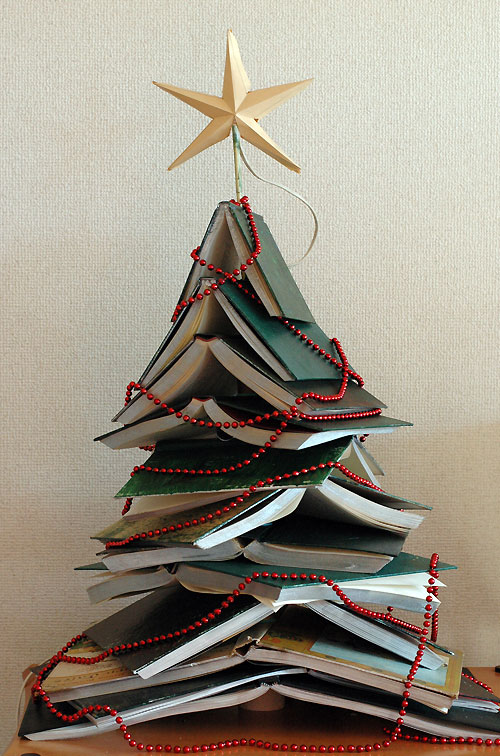
Wishing you and yours a wonderful Christmas weekend and happy holidays filled with family, food and fabulous fiction (non-fiction, too).  This seems to be the year for Christmas trees made of books. There are many wonderful ones to see. This one is from Media Tinker.  Read how to make and light one like it here: http://www.mediatinker.com/blog/archives/010731.html.

Monday, December 19, 2011

Nothing to Envy: Ordinary Lives in North Korea by Barbara Demick

When I woke up this morning and saw that Kim Jong-Il, the North Korean dictator had died, I was thankful that I had read Nothing to Envy a few months ago.  I immediately understood why the dollar had risen and other currencies had fallen due to fears of instability in the region.  I also realized that Kim’s death was entirely different than Muammar Gaddafi’s in Libya where changes engendered by the Arab spring uprisings with their “Ding dong, the witch is dead” aura were brought about primarily because young people there knew about the rest of the world and they wanted a piece of it.  If you look at satellite photos of the region at night you’ll see an enormous black hole – it’s North Korea, land of no electricity.  Nothing to Envy portrays this country where citizens who rarely have access to cell phones or satellite news worship Kim because his version of the facts is all they know.  That any single person could have such a hold on a country seems unfathomable until you read Nothing to Envy.  There you’ll learn of a country where malnourished school children praise Kim in songs asserting that they “have nothing to envy in this world.”

This is a quick post as I simply want those looking for last minute gifts to consider this book for anyone who wants to know more about the world and to make sure you read it soon yourself.   On my annual list I noted that Nothing to Envy depicts the complexities of life in North Korea.  Told through the stories of six North Koreans, it conveys unimaginable brutality. That most of North Korea spent the nineties literally in the dark without electricity, food, or medical care is sad but even sadder is that they were so brainwashed that they could watch children die of starvation and still believe what their government told them because they assumed that things were worse elsewhere. Within a four-year period North Korea’s entire frog population died because so many were killed as there was no other food.  The resilience of the profiled six is uplifting so the book is not a depressing read.

That we know so little about a country that has the potential to do so much harm to our world is disheartening.   That Barbara Demick was able to reach behind the curtain to expose it and make it personal is our gain. Nothing to Envy was a finalist for both the National Book Award and the National Book Critics Circle Award.

Summing it Up:  Read this to understand North Korea and why its volatility is a threat to the world. Suggest it for your book club and get ready for an enlightening discussion.

Rating: 5 stars    Category: Non-Fiction, Super Nutrition, Book Club

Publication date: December 29, 2009


What Others are Saying: